On December 10, the Metropolitan Transportation Commission, the regional agency that manages the Clipper fare payment system in the Bay Area, rolled out the second generation of the system, which it has been preparing to implement for the past few years. As part of this rollout, card reading equipment has been replaced or updated at stations and on transit vehicles across all transit agencies. The second generation is designed to support “open payment” and offer fare discounts for trips involving multiple agencies, which can provide significant fare reductions.
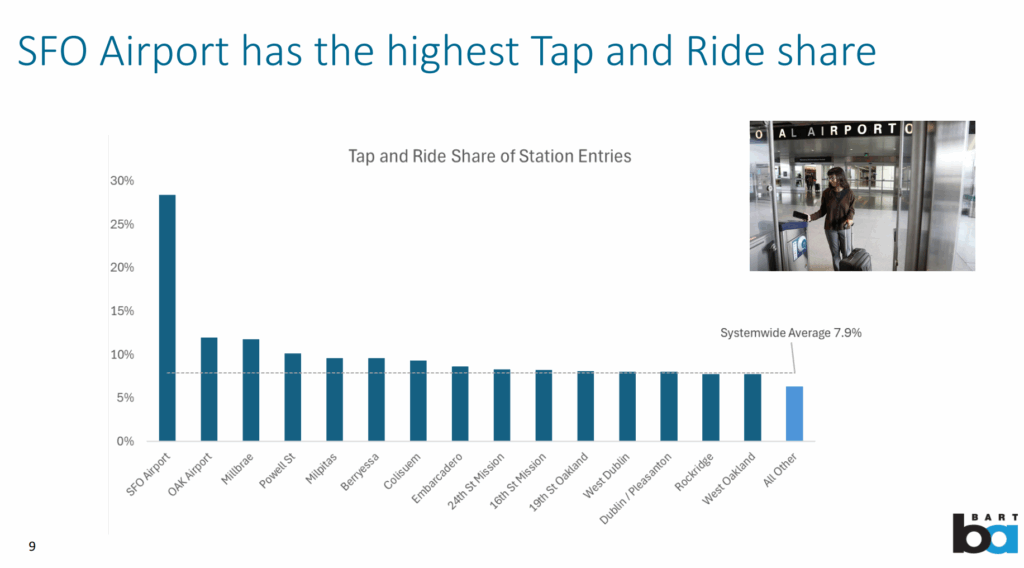
The open payment features allow riders to pay fares directly with a contactless debit or credit card, or with Apple Pay or Google Pay, without needing a physical or virtual Clipper Card. BART implemented this feature in late August. With this rollout, the feature will expand to all agencies that accept Clipper. For BART, after a month of implementation, about 8% of riders use contactless debit or credit cards daily, with higher rates on weekends and event days. Contactless bank card usage at SFO is even higher, reaching nearly 30%. This feature has benefited occasional and out-of-town riders by eliminating the time and hassle of acquiring a physical or virtual card. With the full rollout, riders can board the bus without exact change or a Clipper card and pay with a contactless debit or credit card instead.
Another key feature is the interagency transfer discounts. With Clipper 2.0, riders pay full fare on the first trip and receive a transfer discount of up to $2.85 on the next agency when transferring within two hours. This provides significant savings for certain commutes involving two agencies, such as trips across the Bay on BART or AC Transit to Downtown San Francisco, then transferring to Muni for jobs outside downtown, or trips from the South Bay on Caltrain to Downtown San Francisco with a transfer to Muni at 4th & King Station. It also benefits riders living near local transit system boundaries, such as Daly City and Palo Alto. Regional transit systems like Caltrain and BART have experienced significant and sustained ridership declines since the start of the COVID pandemic. Making interagency trips less costly can help improve ridership recovery for these systems and divert more trips paralleling BART and Caltrain that are currently made by single-occupancy automobiles. The interagency transfer discount is also available to riders paying with contactless debit or credit cards.
What makes Clipper 2.0 different is that it is an account-based system, whereas the original Clipper system is card-based. In the original system, primary data is stored on the cards and the readers on transit vehicles, with data exchanged with the central server only intermittently. This approach was necessary in the 1990s and early 2000s due to limited technology and data bandwidth. The downside was that fare options were limited, and funds or tickets added through the Clipper website might not be usable for days. Account-based systems move most calculations and data to central servers, similar to many apps we use daily on our smartphones. They also allow open payment options that card-based systems couldn’t provide.
Despite the benefits of open payment, riders eligible for fare discounts—youth, seniors, disabled, and low-income individuals—should apply for and use a special Clipper card, or use paper tickets or pay cash fares for systems other than BART. Full fares are charged when contactless debit or credit cards are used. Multiple paper tickets purchased with a single card transaction may be preferred for family trips on certain systems because, with Clipper, each rider needs their own card, whether it’s a Clipper card or a contactless debit or credit card. Also, Clipper users will no longer see their fare balance on the onboard readers and at BART faregates; they should check their balance on the Clipper app instead.
With the full rollout, existing Clipper users can use their cards as usual. MTC plans to migrate these cards to the new servers over several weeks, as millions of cards are currently in circulation. To access new features sooner, current users can log in to the Clipper website or the updated app, which will trigger the migration process.
For Caltrain monthly pass holders, the transition to Clipper 2.0 will require tagging on and off at stations for every trip. Previously, monthly pass users only needed to tag on and off for the first trip of the month to activate the pass; no further tagging was needed as long as the trip was within the zones the pass covered or on weekends. Under the old Clipper system, monthly pass holders had to purchase an upgrade on paper or through the now-retired Caltrain app if they traveled beyond the covered zones. If they tagged on and off with Clipper for any trip outside those zones, they were charged the full fare. With Clipper 2.0, fare upgrades will be applied instead. Although there are many improvements, the necessity to tag on and off remains a significant inconvenience, along with the worry of being cited for forgetting to tag on or being overcharged for forgetting to tag off.
The original Clipper system (first known as Translink) is more than 20 years old, which is quite outdated for a technology product. Clipper 2.0 is an important update, not only to keep the system maintainable for the future but also to add new features that customers now expect, especially given the rapid changes in the private sector. When the original Clipper was introduced, people hailed or called to request taxicabs and paid cash for fares. Today, TNCs such as Uber and Lyft are major competitors to transit, with all ride requests and payments handled on smartphones. In the near future, autonomous vehicles will further increase competition and contribute to road congestion.
The new system will enable agencies to improve pricing strategies to encourage usage and promote fare equity. Instead of pre-paid passes, agencies can implement daily, weekly, or monthly fare caps, giving low-income riders more flexibility to pay. For Caltrain, this means transitioning from rigid fare zones to station-to-station fares. Currently, the fare for traveling between San Bruno and Millbrae is the same as traveling between San Francisco and Redwood City. Transit agencies can implement special fares within the Clipper system, rather than outside the system with riders buying paper tickets, paying fares in cash, or use dedicated agency apps.