On November 5, the managing agency for the Amtrak San Joaquins service formally changed the service’s name to the Gold Runner. The primary reason for this change is that Amtrak owns the servicemark rights to the San Joaquins name. With the new name, the San Joaquin Joint Powers Authority (SJJPA), which manages the service, will own the brand. This opens new possibilities, including allowing an entity other than Amtrak to operate the service.
SJJPA’s managing agency, the San Joaquin Regional Rail Commission, also operates the Altamont Corridor Express (ACE). The agency is involved in various regional and intercity rail expansion efforts to extend ACE north from Stockton to Sacramento and south from Lathrop to Modesto, eventually reaching Merced. South of Merced, the High Speed Rail Authority is constructing the initial phase between Merced and Bakersfield.
With the first segment of high-speed rail expected to open early in the next decade, along with the completion of ACE extensions, there is interest in realigning the existing Gold Runner service to serve as a feeder for high-speed rail and provide seamless connections. Conventional regional and intercity trains would connect Oakland and San Jose on separate corridors with high-speed rail. SJJPA may also manage service on high-speed rail tracks, as they do for the conventional Gold Runner service, to ensure integration.
With the administration led by the Felon, there are mass layoffs across the federal government, unconstitutional executive orders, and threats to funding for seemingly secured infrastructure projects. The Secretary of Transportation recently ordered a review of the California High Speed Rail project, hopefully to find some “waste and fraud”, with the possibility of cutting off funding previously granted by past administrations.
The California High Speed Rail project is in a difficult spot. The cost to complete the full project from Los Angeles to San Francisco far exceeds the original estimate from 20 years ago. Since voters approved Proposition 1A in 2008, progress has been far too slow. Although the project recently completed all environmental documents for the entire corridor, there is no funding available to finish it. The project is opposed by the state’s Republican Party, who see this as an opportunity to end it, similar to how the Felon and Elon Musk ended USAID. Could it happen that way? Should it happen that way? I am not so sure, even though I have many doubts about the direction the California HSR is going, especially compared to the Brightline West project connecting Las Vegas and Rancho Cucamonga.
The current alignment requires costly rail overcrossings in several places, such as in Wasco. HSR is to run alongside with existing freight rail lines. Source: California High Speed Rail AuthorityBrand new rail right of way with a large curve radius cuts through farms in Madera. Also built is a vehicular overcrossing. Source: California High Speed Rail Authority
The slow progress of CAHSR was set in motion 20 years ago. The state aimed for a single high-speed rail backbone, connecting downtown to downtown, serving the Silicon Valley, Central Valley cities, and the High Desert, with trains faster than typical high-speed trains in Europe, as set by the 2 hour and 40 minute requirement under Proposition 1A. These political requirements and lofty goals explain the alignment on the east side of Central Valley, near State Route 99. Although Union Pacific and BNSF freight railroads serve this corridor (with Amtrak San Joaquins trains running on the latter), these railroads, for operational and business reasons, could not and did not want to share tracks or right of way with the HSR. Additionally, due to the high speeds, very large curve radii are required, far exceeding those of current railroads. Consequently, HSR needed a new right of way, even if adjacent to existing freight rail or freeways, necessitating the purchase of land from farmers and homeowners. The process of acquiring land had been slow and costly.
On the other hand, Brightline West will be built on the freeway median of Interstate 15, primarily using a single track with passing tracks at various points. Choosing the freeway alignment resolved most right-of-way issues, as it is already publicly owned. This alignment also addresses street crossings, as streets are grade-separated from the freeway. Additionally, the project will not have to deal with freight railroads or interfere with their operations.
If CAHSR had followed the path taken by Brightline West, the rail line would have used the Interstate 5 alignment, crossing over the Grapevine and Altamont Pass. The final stop might not have been in Downtown San Francisco or Downtown Los Angeles, but it would be close enough to the region—far better than Bakersfield and Merced, the endpoints of the current phase of the project. It might have been led and partially funded by private investors, similar to Brightline West. Originally, the CAHSR Authority anticipated private investments as part of the funding plan under Proposition 1A, but this never came to fruition.
The Obama administration approved the strategy of building the Central Valley first to showcase true high-speed rail (surpassing the Northeast Corridor) in the United States. However, I believe they made cost and construction progress projections during an economic downturn when construction companies and unions, eager for work, underbid for such projects. Since then, the economy has recovered, and unemployment has hit a record low. Inflation is now a major concern, and with high inflation, interest rates are also high. Even without waste and fraud, the current economic conditions work against CAHSR and other agencies pursuing major infrastructure projects.
Some critics of the CAHSRA may still support HSR but want a complete reset. However, I don’t see any benefit in killing the project now. Despite challenges, the agency has largely secured the right of way, and many bridges and structures have been built. A sudden course change, like shifting alignment to I-5, won’t save money now. Even pausing the project, assuming funding resumes after the current administration, won’t save money due to inflation. At best, the agency could save by deferring certain elements like electrification. I believe the best course is to complete the initial segment to the point where trains can operate, and then determine the next step forward, free of political constraints from past decisions by CAHSRA and Prop 1A.
For a long time, I have been wary of large capital projects. I prefer a series of smaller projects that can be completed faster with less funding. These smaller projects bring benefits sooner, and successful completions help build momentum for further improvements. Caltrain is a good example. It launched the “Baby Bullet” project after then-state senator Jackie Speier successfully secured funding from the state surplus in 2000. The agency started construction in 2002 and completed it in 2004. The new express trains reduced travel time to less than an hour, and ridership increased every year until 2020 when COVID hit and stay-at-home orders were issued. Caltrain’s success with the Baby Bullet helped build support for electrification, as it would be the next step to increase corridor capacity.
When the decision was made to build the Central Valley segment first, there were concerns that urbanized regions in the Bay Area and Los Angeles wouldn’t see any benefits for many years. Consequently, decisions were made to fund projects like Caltrain electrification, which could be built sooner, improve regional transit in the meantime, and eventually become part of HSR. It’s important to note that because most of the HSR funding is spent in the Central Valley, the project remains largely unseen by those in the Bay Area and Los Angeles unless they visit one of the Central Valley cities. It is also invisible to I-5 travelers, the primary driving route between the Bay Area and Los Angeles.
This regime likes to create chaos everywhere, and it will likely do the same for HSR and other transit projects in California. Since so much has already been built, it would be unfortunate for the state to abandon high-speed rail. Changing course now would only make the program more expensive and take longer to complete. Hard decisions may need to be made on how to keep the project going while federal funding is withheld. We can’t afford to leave those structures unfinished and unused, allowing them to become symbols of government ineffectiveness.
Governor Gavin Newsom made a significant announcement on High Speed Rail during his State of the State address:
We're going to make high-speed rail a reality for CA. We have the capacity to complete the rail between Merced and Bakersfield. We will continue our regional projects north and south. Finish Phase 1 enviro work. Connect the Central Valley to other parts of the state.
Some say that he’s stopping high speed rail, but clearly he doesn’t intend to stop whatever’s being built on the ground. Is he somehow against high speed rail altogether? I don’t think so. Some people think that Newsom should just continue the project as originally planned, but considering the difficulties over the last decade a “timeout” is long overdue.
What is clear is that according to the current high speed rail business plan, it would require far more funding and would take much longer to complete. It would require a significant commitment, not only from the current generations of politicians, but from the future generations a decade or two to come. It is just a matter of time that someone hits a pause button.
Without new funding sources, the state would have to divert funds from existing transportation projects.
But more than that, the high speed rail project has several barriers due to some longstanding unresolved issues.
Prop 1A language
Prop 1A, the ballot measure that enabled the high speed rail project, is unusual that it contained several “performance measures” that specified the travel time. While on one hand it appears like a marketing language in a car brochure about the vehicle’s capability, it also placed constraints because the only way to amend a language in a ballot measure is with another ballot measure, or unless a judge agrees that what the authority is doing still somehow complies with the ballot measure. As a result, the project suffered a series of lawsuits. Entities that disagree with the authority can take the issue to the court and drag the lawsuit for years to come.
Voters were told that the high-speed trains would hit 220 mph, get from Los Angeles to San Francisco in two hours and 40 minutes, operate without subsidies and obtain funding and environmental clearances for entire operating segments before construction.
It was the state legislature that drafted the Prop 1A language and the High Speed Rail Authority that endorsed it. Why would the state and the agency commit to a requirement that they cannot fulfill? The reason is that there are different visions among the legislators and HSRA board members regarding high speed rail. Some people, like Quentin Kopp, who was the chairman of the HSR Authority during the time when Prop 1A was drafted and placed on the ballot, believe that high speed rail should be a dedicated, segregated system similar to Japan. On the other hand, other high speed rail supporters believe in a European version of the trains where high speed trains can share tracks with local trains.
That dispute wasn’t settled even well after Prop 1A was approved. In 2009, the authority released a 4 track segregated plan for the Peninsula Corridor. Kopp believed in a 4 track segregated plan as it would clearly meet the performance goals as required by the Prop 1A language, but many local cities, who have endorsed Prop 1A when it appeared on the ballot, thought high speed rail would be blended with Caltrain. They wouldn’t have supported the ballot measure if they had known that a 4 track system was planned.
The 2009 plan met with huge resistance from the communities. A blended system compromise was reached and approved by the state legislature, but it was challenged in court from those who do not want to see any infrastructure improvement on the rail corridor.
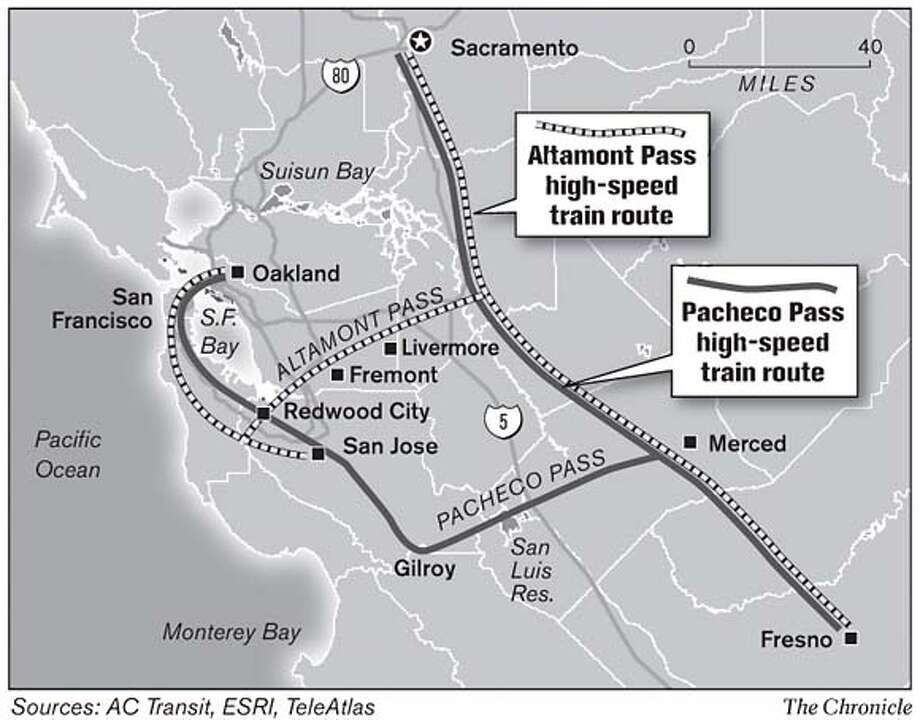
Altamont vs. Pacheco
The alignment between the Bay Area and the Central Valley has also been a long ongoing struggle, despite the fact that Pacheco has been a designated high speed rail corridor for years even before Prop 1A was drafted.
The advantages of the Altamont Corridor:
Shorter travel time from San Francisco to LA than Pacheco.
It is along an established rail corridor over the Dumbarton Rail Bridge and Altamont Pass.
San Jose would be served by a line from Fremont to San Jose, while it would take longer to LA but would be shorter to Sacramento if line to Sacramento were built.
Able to serve more of the Bay Area commute-shed such as Tracy and Modesto and get the line closer to Sacramento.
The advantages of the Pacheco Corridor:
Shorter travel time from San Jose to LA
Would operate along the entire length of the Caltrain corridor. Every train to/from SF would go through San Jose, rather than be served by a branch.
Get the line closer to the Monterey Bay Area.
Led by Rod Diridon, a long time High Speed Rail Authority board member, the San Jose interests were able to convince the agency to select the Pacheco alignment and drop the Altamont Pass from further consideration. They like the idea of having Diridon Station be a hub along the main line and not a terminal of a branch line. Those who support the BART extension from Fremont to San Jose would have one less potential competition.
The HSR Authority, still recognizing that the Altamont is still a key commute corridor, funded a separate study to improve the Altamont Pass to become a feeder corridor to the High Speed Rail system, but the project has gone nowhere after the initial study. Although the concept has support in the San Joaquin County where it is a part of the Bay Area commute shed, it has little support in the Tri-Valley and the Silicon Valley, where they focus on extending BART.
Although not as controversial as Altamont vs. Pacheco, the selection of the Tehachapi pass is not without detractors. The Authority chose the Tehachapi pass because of the political support from the desert communities (a commute shed for the Los Angeles area). Also by routing through the desert, it could be a link for rail line to Las Vegas.
But none the less the Tehachapi pass appears to be a detour compare to I-5, and especially in light of the performance criteria set by Prop 1A. Also the Tehachapi pass requires the line to go through Bakersfield. Although High Speed Rail proposed a station in Downtown Bakersfield as policy recommended, its operational demands require a much bigger footprint that is incompatible with a quiet, conservative city. The rail authority had to reconfigure its plan to avoid downtown.
What could be salvaged?
For those who want to walk away: Abandoning high speed rail means we will have wasted billions of dollars with nothing but broken promises and lawsuits to show for it. I'm not interested in sending $3.5B in federal funding–exclusively allocated for HSR–back to the White House.
Rail supporters and many HSR critics agree that whatever is being built must be finished. But is the end product be a train from nowhere to nowhere? With proper planning I think it is possible to have an end product where trains can serve the Bay Area and/or Sacramento that is faster than Brightline, a “high speed rail” line in Florida, or Acela in the East Coast. It may not be Japan, but it could be more like Europe if not America.
The state has ordered locomotives and railcars for its Amtrak fleet that are the same as those used by the Brightline in Florida, all produced by Siemens in Sacramento. They will have the capability to operate at 125 mph.
Currently the Amtrak San Joaquin trains go to Sacramento and Oakland. These trains can operate at high speed on HSR tracks and at conventional speed outside of HSR tracks, but still provide direct service.
There are already projects to improve rail corridors in the upper San Joaquin Valley area to extend ACE and improve Amtrak service, which include ACE extension as far as Merced, where the current phase for high speed rail construction is supposed to end. Also in a rare move, Union Pacific made one of its rail corridor between Stockton and Sacramento available to passenger rail.
In previous business plans, they talked about some kind of coordinated service upon the completion of the 1st HSR segment in the Central Valley. However the concept is vague and has gone nowhere beyond showing up on the documents. This is time to address it.
Construction of the initial operating section of High-Speed Rail is planned to be completed in 2018. This initial section of tracks will be put to use immediately upon completion and deliver early benefits by allowing the existing San Joaquin route to operate on the new tracks until the initiation of full High-Speed Rail service. With creation of the “Northern California Unified Service,” the San Joaquin route, ACE, and Capitol Corridor trains will be enhanced and operated in a more integrated manner, creating an improved network reaching from Bakersfield to the San Francisco Bay Area and Sacramento.
State Rail Plan FAQ http://www.dot.ca.gov/californiarail/docs/130130_csrp_faq.pdf
Once everything is done, it would up to future voters and future politicians to decide where to build and where to improve. The mistakes written into Prop 1A would no longer hamper them.
I think Newsom understands that High Speed Rail should be done differently, but at this current political environment it is hard to continue commitment given the constraints set by Prop 1A. If the idea is to provide new funding or make big changes to the program, he would have to get voter approval, which wouldn’t be feasible until there’s something to show, some train running somewhere. So I agree that the priority is to get the Central Valley segment done. Newsom’s announcement may seem to be a mixed message whether you’re for or against high speed rail, but for me his intention is crystal clear. The flaw of Prop 1A is that it requires the state to be perfect in its execution, but it is being weaponized by those who don’t want us transitioning to a green economy, and we cannot allow them to have that.
Fake news. We’re building high-speed rail, connecting the Central Valley and beyond.
This is CA’s money, allocated by Congress for this project. We’re not giving it back.
The train is leaving the station — better get on board!