Tag Archives: SamTrans

Clipper 2.0 rolls out, offering new features

On December 10, the Metropolitan Transportation Commission, the regional agency that manages the Clipper fare payment system in the Bay Area, rolled out the second generation of the system, which it has been preparing to implement for the past few years. As part of this rollout, card reading equipment has been replaced or updated at stations and on transit vehicles across all transit agencies. The second generation is designed to support “open payment” and offer fare discounts for trips involving multiple agencies, which can provide significant fare reductions.

The open payment features allow riders to pay fares directly with a contactless debit or credit card, or with Apple Pay or Google Pay, without needing a physical or virtual Clipper Card. BART implemented this feature in late August. With this rollout, the feature will expand to all agencies that accept Clipper. For BART, after a month of implementation, about 8% of riders use contactless debit or credit cards daily, with higher rates on weekends and event days. Contactless bank card usage at SFO is even higher, reaching nearly 30%. This feature has benefited occasional and out-of-town riders by eliminating the time and hassle of acquiring a physical or virtual card. With the full rollout, riders can board the bus without exact change or a Clipper card and pay with a contactless debit or credit card instead.
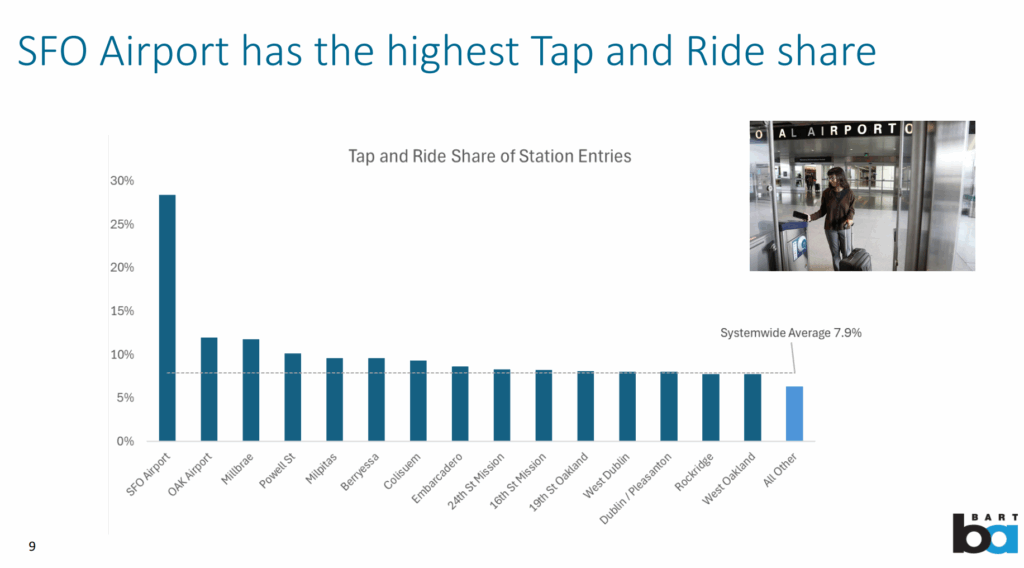
Source: BART

Another key feature is the interagency transfer discounts. With Clipper 2.0, riders pay full fare on the first trip and receive a transfer discount of up to $2.85 on the next agency when transferring within two hours. This provides significant savings for certain commutes involving two agencies, such as trips across the Bay on BART or AC Transit to Downtown San Francisco, then transferring to Muni for jobs outside downtown, or trips from the South Bay on Caltrain to Downtown San Francisco with a transfer to Muni at 4th & King Station. It also benefits riders living near local transit system boundaries, such as Daly City and Palo Alto. Regional transit systems like Caltrain and BART have experienced significant and sustained ridership declines since the start of the COVID pandemic. Making interagency trips less costly can help improve ridership recovery for these systems and divert more trips paralleling BART and Caltrain that are currently made by single-occupancy automobiles. The interagency transfer discount is also available to riders paying with contactless debit or credit cards.

What makes Clipper 2.0 different is that it is an account-based system, whereas the original Clipper system is card-based. In the original system, primary data is stored on the cards and the readers on transit vehicles, with data exchanged with the central server only intermittently. This approach was necessary in the 1990s and early 2000s due to limited technology and data bandwidth. The downside was that fare options were limited, and funds or tickets added through the Clipper website might not be usable for days. Account-based systems move most calculations and data to central servers, similar to many apps we use daily on our smartphones. They also allow open payment options that card-based systems couldn’t provide.

Despite the benefits of open payment, riders eligible for fare discounts—youth, seniors, disabled, and low-income individuals—should apply for and use a special Clipper card, or use paper tickets or pay cash fares for systems other than BART. Full fares are charged when contactless debit or credit cards are used. Multiple paper tickets purchased with a single card transaction may be preferred for family trips on certain systems because, with Clipper, each rider needs their own card, whether it’s a Clipper card or a contactless debit or credit card. Also, Clipper users will no longer see their fare balance on the onboard readers and at BART faregates; they should check their balance on the Clipper app instead.

With the full rollout, existing Clipper users can use their cards as usual. MTC plans to migrate these cards to the new servers over several weeks, as millions of cards are currently in circulation. To access new features sooner, current users can log in to the Clipper website or the updated app, which will trigger the migration process.

For Caltrain monthly pass holders, the transition to Clipper 2.0 will require tagging on and off at stations for every trip. Previously, monthly pass users only needed to tag on and off for the first trip of the month to activate the pass; no further tagging was needed as long as the trip was within the zones the pass covered or on weekends. Under the old Clipper system, monthly pass holders had to purchase an upgrade on paper or through the now-retired Caltrain app if they traveled beyond the covered zones. If they tagged on and off with Clipper for any trip outside those zones, they were charged the full fare. With Clipper 2.0, fare upgrades will be applied instead. Although there are many improvements, the necessity to tag on and off remains a significant inconvenience, along with the worry of being cited for forgetting to tag on or being overcharged for forgetting to tag off.

The original Clipper system (first known as Translink) is more than 20 years old, which is quite outdated for a technology product. Clipper 2.0 is an important update, not only to keep the system maintainable for the future but also to add new features that customers now expect, especially given the rapid changes in the private sector. When the original Clipper was introduced, people hailed or called to request taxicabs and paid cash for fares. Today, TNCs such as Uber and Lyft are major competitors to transit, with all ride requests and payments handled on smartphones. In the near future, autonomous vehicles will further increase competition and contribute to road congestion.

The new system will enable agencies to improve pricing strategies to encourage usage and promote fare equity. Instead of pre-paid passes, agencies can implement daily, weekly, or monthly fare caps, giving low-income riders more flexibility to pay. For Caltrain, this means transitioning from rigid fare zones to station-to-station fares. Currently, the fare for traveling between San Bruno and Millbrae is the same as traveling between San Francisco and Redwood City. Transit agencies can implement special fares within the Clipper system, rather than outside the system with riders buying paper tickets, paying fares in cash, or use dedicated agency apps.

Transit agencies should firmly embrace diversity

On the night of January 29, 2025, a military helicopter collided with a small passenger airliner in Washington D.C., just as the airliner was about to land at Reagan National Airport. The next morning, while first responders worked to recover the scene and families of the passengers tried to heal from the tragedy, the nation’s first Felon in Chief quickly blamed diversity initiatives and the previous administration for the crash, despite having no evidence.

During the presidential campaign, the Felon consistently attacked diversity initiatives, using “DEI” as a euphemism for derogatory terms: “so and so (of woman or a minority race) is a DEI hire…” implying incompetence based on race or gender. Since his inauguration, he has signed several executive orders to end DEI programs in federal agencies and encouraged federal employees to report colleagues working on those initiatives.

Aside from his well-documented history of racism, his current actions may stem from a personal vendetta against the Black Lives Matter movement during the 2020 presidential campaign he lost. Alternatively, dementia may have affected him to the point where his extremist handlers manipulate him to achieve their personal goals.

I see diversity initiatives as direct actions to undo racism and other types of discrimination. While direct discrimination has long been outlawed and disavowed, prejudices and stereotypes still persist. Diversity initiatives help us to recognize our own biases and look beyond stereotypes. It helps to reduce tension in workplaces and communities.

I have always supported diversity initiatives because I believe they are necessary to prevent painful consequences. During high school, I witnessed the Rodney King saga on TV: police brutality caught on camera, a court trial outcome many thought was unjust, and a riot in Los Angeles fueled by pent-up anger over racial discrimination, which pitted ethnic communities against each other. I’ve also witnessed the ugly campaign waged by then-Governor of California Pete Wilson against undocumented residents with Proposition 187, which stirred up fears in immigrant communities. While that proposition passed (and the court struck down many of the elements) and he served two terms, his actions inadvertently turned the Republican Party in California—home to two modern GOP presidents, Nixon and Reagan—into a permanent minority party, largely unable to win statewide seats.

For many years, community activists have urged transit agencies throughout the United States to pursue social equity, as these agencies determine the level of service and infrastructure investments in various areas. During the 1950s and 1960s, with federal funding, new freeways were built to support emerging white communities, dividing and bulldozing communities of color across the US. Later, in the 1990s, transit agencies pursued suburban rail expansions with federal funds but faced pushback from transit activists. These activists wanted investments redirected to bus services in the inner core, which had a higher minority population. This effort was successful in Los Angeles and Metro Rapid service was introduced in response. To be responsive to community demands and better serve their constituents as both service providers and employers, many agencies are interested in diversity initiatives, especially following the Black Lives Matter movement.

The murders of George Floyd and Breonna Taylor and the Black Lives Matter movement sparked a national conversation about race in 2020. Those events led to significant growth in leadership roles focused on diversity, equity, and inclusion (DEI), forced transit agencies to reconsider their approach to policing on their systems, and required agencies to revisit their relationships with riders of color.

-The Transit Equity Report by American Public Transportation Association, September 2024.

In the transit industry, although racial diversity exists at the lower levels of the workforce, the industry is largely male-dominated. The executive level remains predominantly white. Without efforts to improve diversity in recruitment, advancement, and awareness, this divide, with its inherent racial and gender biases, may foster a sense of distrust and injustice in a transit agency, affecting both employees internally and riders and the community externally.

Recognizing and appreciating diversity also improves employee morale, enhances decision-making, and decreases worker turnover. This is essential since many agencies have faced operator shortages in recent years, hampering service and ridership recovery after the COVID pandemic. As an example, Santa Clara VTA is partnering with a local ATU to empower women frontline transit workers and address unique needs, such as safety issues and restroom access.

Safety is paramount in the transportation business, whether it’s aviation, railroad, or transit. The safety culture that many companies and agencies strive for requires strict adherence to standards and procedures, and demands a sense of truthfulness and fairness from all transportation workers, whether at the executive level or in customer-facing roles. Diversity initiatives can enhance safety culture by fostering a collaborative atmosphere rather than relying solely on a top-down command hierarchy. This approach focuses on finding solutions and avoiding unsafe situations instead of letting accidents happen and assigning blame.

The notion that someone who has benefited from DEI policies is incompetent or wouldn’t be qualified without lowered standards is not what DEI policies intend to convey. One of the reasons for greater racial diversity at lower levels of transit employment, such as transit operators, is the paid training offered by transit agencies. Candidates for these jobs don’t face the training barrier present in other fields where applicants must pay for their own education. It is well-known that there is systemic bias against minorities in accessing quality education, with cost being a factor. Since the trainees will work for the agencies after training, lowering standards that compromise safety would be counterproductive and costly to the agencies.

Those who advocate against DEI say they’re for meritocracy, but I think what they really meant is toxic “bro” culture. This notion of meritocracy often gets twisted to justify exclusionary practices that favor a certain group over others, under the guise of performance. It’s as if they equate being part of the “in crowd” with actual capability.

A prime example of an employer promoting a toxic “bro” culture is Abercrombie & Fitch under the leadership of then CEO Mike Jeffries from the ’90s to 2014. The company marketed its brand as being for “the attractive, all-American kids.” While the brand’s “white hot” image was very profitable during that era, it also discriminated against racial minority employees for not fitting the white, preppy look and attracted numerous discrimination lawsuits. Even though a fashion company is very different from a transit agency, a toxic culture is equally harmful in both.

Someone appointed to the role not based on merit but rather a toxic “bro” culture issues a tweet falsely claiming that celebrating diversity compromises safety. Making workers feel valued and respected is never a distraction.

The idea that DEI prevents employers from hiring the “best and brightest” is also far from the truth. Most jobs, especially in transportation, don’t require artisanal or creative skills; only competency is necessary to perform them safely. It’s unrealistic to view every job as a sports championship, where candidates must fight hard against each other for the spot and the person hired is considered the best. A decade ago, when public transit jobs were preferred and had more applicants than positions, transit agencies were more selective, making positions harder to qualify for. However, as baby boomers retire, and companies like Uber and Lyft offer more flexible driving gigs, along with more work-from-home jobs available elsewhere, fewer people are applying for transit jobs. Diversity initiatives, especially those targeting women, can help attract more qualified candidates to this traditionally male-dominated field. Even in artisanal and creative positions, people from diverse backgrounds bring new perspectives and can break through the groupthink common in “bro” culture.

Transit agencies understand how to honor diversity while promoting safety. Only those with ulterior motives claim otherwise. Source: SamTrans

A petty and ill-conceived ban on diversity initiatives at the federal level will harm workers and negatively affect everyday Americans who interact with federal agencies. For those who are pushing to ban them, part of the plan is to cause pain. Unfortunately, some large employers, influenced by the false notion of DEI and meritocracy, chose to end their diversity programs as well. Transit agencies, governed at the local level, should know better and firmly reject calls to end these initiatives. They should also resist attempts by the federal government to impose its will through executive actions without Congress’s approval. Embracing diversity improves safety, enhances relations with transit riders and community members, and boosts employee satisfaction.

APTA had page about its initiative on DEI in Fall 2024, and now that page has been removed online, following anti-DEI executive orders.

A ballot measure for a bus only driveway

The Caltrain station in downtown Palo Alto serves as a major transfer point between SamTrans (serving San Mateo County to the north), VTA (serving the rest of Santa Clara County to the south), the Dumbarton Express to the East Bay, and the Stanford shuttles. Currently, buses can only access the transit center via University Avenue, which is often congested with car traffic in downtown Palo Alto on the other side of the Caltrain tracks.

Red line – Current bus routing
Blue line – Bus routing through new driveway
Continue reading A ballot measure for a bus only driveway

SamTrans to revisit busway on Dumbarton Corridor

On the agenda for the SamTrans Board of Directors July 10, 2024 meeting is an action item to request funding for a study of putting a busway on Dumbarton Rail Corridor. Unlike the previous attempts that considered bus and rail options (including pods) through the entire corridor from Fremont/Newark to Redwood City, this time the agency is only looking to build a busway on the San Mateo County side between Redwood City and East Palo Alto, on the rail right of way that the agency owns.

Continue reading SamTrans to revisit busway on Dumbarton Corridor

San Mateo Bridge Transit

A fact of life on the Peninsula is that during rush hours, the 101 freeway is jammed in both direction leading to SR-92 and SR-92 is also jammed leading to the San Mateo Bridge. Unfortunately, unlike nearly all other Bay Area bridges, this bridge has no transit option currently for the general public nor a route for cyclists. Commuters either have to drive themselves, make informal arrangements for carpool, lucky enough to have employer sponsored shuttles, or use other bridge corridors on transit or bike/micromobility. Why hasn’t transit worked for the San Mateo Bridge?

Remaining portion of original bridge that turned into a pier (right). High rise portion of the current bridge (left).

Even though the San Mateo-Hayward Bridge first opened to traffic in 1929, and being the second road bridge to be opened crossing San Francisco Bay (after Dumbarton Bridge), I was not able to find history of scheduled bus service on the bridge before SamTrans introduced the 90E route between San Mateo and Hayward BART in 1977. In the early decades, the Peninsula and East Bay regions outside Oakland and Berkeley were mostly rural. Primary transbay transit service was ferries from Oakland and eventually interurban rail and buses over the Bay Bridge.

Continue reading San Mateo Bridge Transit